Beyond the Reference Range: How AI-Assisted Interpretation Is Reshaping What Clinics Deliver Alongside Blood Test Results
A blood test is often the most information-dense event in a patient's year. Panels capture dozens of biomarkers reflecting liver health, metabolism, inflammation, lipids, nutrients, and blood cell function — a snapshot of physiology that no conversation alone could produce. Yet the document patients receive afterward, a table of analytes and reference ranges, gives most of that information back in a form they cannot use.
The consequence plays out in clinics every day. Patients google their flagged values on the way home, worry about numbers that are clinically trivial, and stay silent about trends that matter. Doctors, meanwhile, spend appointment time reconstructing results from different laboratories and different years before any interpretation can even begin. The data exists. The understanding has to be assembled by hand, every single time.
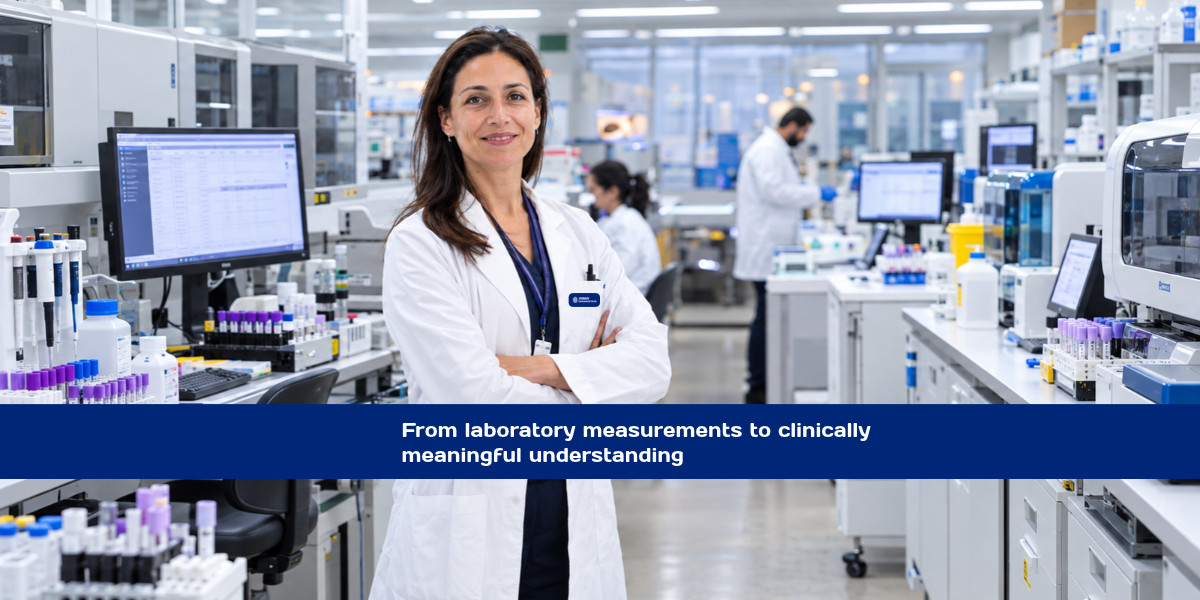
This is the problem Aima Diagnostics was built to solve. Founded by Sergey Smirnov and registered in the United States and Norway, the company has created an AI-assisted interpretation layer that transforms laboratory output into structured, plain-language, longitudinal insight — for patients, clinicians, laboratories, clinics, and equipment makers alike. It does not perform assays, and it does not replace medical judgment. It sits between measurement and decision, doing the contextual work that raw reports never did.
What Patients Actually Receive From Their Blood Tests
Consider what a conventional report tells a patient: which analytes were measured, their values, and whether each falls inside a population-derived reference interval. What it leaves out is nearly everything a patient wants to know. Is this abnormal value new? Do these three flagged results relate to each other? Does anything here require urgent attention, or can it wait for the next scheduled visit?
Health literacy research has documented the cost of that silence for two decades. Patients misinterpret reference intervals, overreact to isolated deviations, miss patterns, and seek answers from unreliable corners of the internet. The interpretive gap between a laboratory dataset and a patient's practical understanding is where anxiety, confusion, and missed follow-up live — and it is precisely the gap this platform is designed to close.
The Engine Underneath: Five Connected Functions
The system works as a pipeline rather than a single black box. Results enter either through patient upload or integration with laboratory and clinical information systems. The first step is normalization: because laboratories differ in units, naming conventions, reference intervals, and reporting structures, every result is standardized into a consistent format before comparison is attempted.
Reading Biomarkers as a System, Not a List
Analysis then proceeds on two levels. Each biomarker is evaluated against its applicable reference information, and relationships between biomarkers are examined explicitly — because disease and physiology rarely move one marker at a time. Iron indices shift meaning in the presence of inflammation; glucose results gain depth alongside metabolic and hepatic parameters; lipid fractions are read against one another. The output is cautious pattern recognition, not speculative diagnosis.
The third layer is longitudinal. By retaining results over time, the platform distinguishes an isolated deviation from a persistent trend — the difference between a one-off blip and a trajectory worth discussing. Finally, a constrained reporting layer converts the analysis into plain language, under strict rules: no unsupported diagnostic claims, controlled communication of uncertainty, and mandatory escalation wording when a finding may need prompt clinical attention.
Why Medical Specialists Are Built Into the Product
What separates a responsible interpretation system from a chatbot is governance. Medical specialists participate in developing and reviewing the interpretation logic, clinical language, and safety rules. AI specialists own the architecture, quality control, technical evaluation, and model monitoring. Human oversight, traceability, conservative phrasing, incident review, and change control are treated as preconditions of deployment — an approach aligned with WHO's ethics guidance on AI in health, including its 2024 recommendations for large multimodal models.
The design goal for patients is comprehension without false certainty. A good report explains what may be important, what remains unknown, and what does not establish a diagnosis on its own. It neither inflates minor deviations into crises nor offers reassurance where clinical assessment is genuinely needed — and the company insists the benefit be proven through direct measurement of patient understanding, not assumed from engagement metrics.
A Practical Upgrade for Clinical Workflows
For clinicians, the everyday pain is assembly work: results scattered across dates, laboratories, and formats, trends reconstructed manually, common findings explained from scratch in visit after visit. The platform compresses that work into a structured, reviewable summary with biomarker relationships and longitudinal changes already mapped out.
Deciding whether ai for clinics genuinely shortens review time or improves decision quality is, by the company's own framing, a matter for time-and-workflow studies and clinical evaluation — not something to infer from the technology's existence. The judgment, always, remains with the clinician. That honesty is unusual in health-tech marketing, and it is a core part of the company's positioning.
The Business Case: Extending the Diagnostic Journey
For clinics and laboratories, the platform extends a service that currently ends too early. Once a report is delivered, the patient relationship typically goes dormant until the next test. An interpretation layer turns that endpoint into a continuing capability: understandable results, longitudinal comparison, and a clear rationale for appropriate follow-up — all layered onto existing analytical equipment, with no hardware replacement required.
The company's published case study describes a five-week deployment with a laboratory partner. Six months on, repeat-visit rates had climbed from 12% to 16%, average revenue per patient rose 20%, and complaints about unclear results halved. The company itself labels these figures what they are — observations from a single commercial implementation that suggest hypotheses rather than prove effectiveness. Growth in follow-up, it notes, is only a good thing when the follow-up is clinically appropriate.
Partnerships That Stress-Test the Platform
Collaborations now span the United States, Scandinavia, the United Kingdom, Ukraine, and other European markets — laboratory networks, clinics, universities, and research organizations. Commercial deployments teach integration and operations; academic partnerships enable study of clinical concordance, patient comprehension, workflow effects, and safety. The company draws the line clearly: a pilot is not the same as independent validation.
The most demanding proving ground is a private addiction treatment center in Ukraine. Patients there often present with intertwined abnormalities across liver function, inflammation, metabolism, and nutrition, complicated by comorbidities and medications. In that environment, interpretation means relationships, persistence, and change over treatment — never reference-range arithmetic alone. Just as firmly, the platform refuses to use laboratory data to infer behavior or attach stigmatizing labels; diagnosis stays with qualified professionals.
What Analyzer and Point-of-Care Manufacturers Stand to Gain
Equipment makers face a commoditizing hardware market, and structured interpretation offers a genuine differentiator. The layer can ship with new analyzers as part of their digital environment or connect to installed systems where compatibility and configuration-specific validation allow. In point-of-care settings — pharmacies, community clinics, remote sites — clear reporting and defined escalation pathways matter most, and each configuration is evaluated on its own analytical and regulatory footing. In the United States, the FDA's January 2026 Clinical Decision Support Software guidance further separates clinician-facing from patient-facing software, so regulatory status depends on intended use and claims, not on the product category alone.
Earning the Word "Gold Standard"
The company's most consequential commitment is methodological: a shared, independently verifiable evaluation standard for AI-assisted interpretation. Four dimensions form the proposed minimum — clinical concordance with qualified clinician panels under prespecified protocols, comprehension tested with real patients rather than readability formulas, clinical and workflow outcomes including unintended consequences, and structured safety analysis with explicit error taxonomies and honest denominators. Relevant guidelines exist to anchor this work: TRIPOD-LLM for studies involving large language models, STARD 2015 for diagnostic-accuracy designs. And crucially, the standard would require publishing unfavorable findings alongside favorable ones.
Where Laboratory Medicine Goes From Here
The diagnostic industry has spent half a century perfecting measurement. The next decade will be judged on comprehension: whether a blood test produces not just numbers, but understanding that patients can carry into a consultation and clinicians can act on with confidence. Aima Diagnostics has assembled the pieces that transition demands — clinician-supervised AI, longitudinal context, constrained plain-language reporting, real-world deployments, research partnerships, and an evaluation philosophy willing to hold its own claims to account. For clinics looking to give their patients more than a table of numbers, this is the interpretation layer that finally makes blood work speak.